 Thunder Patches
Home / Blog / Custom chenille patches: what they are, what they cost and when to pick embroidery instead
6 min read
Custom chenille patches: what they are, what they cost and when to pick embroidery instead
Chenille is the fuzzy, raised patch from varsity jackets, and it works on hoodies and merch too. How it is made, which designs suit it, chenille vs embroidered, and real prices.
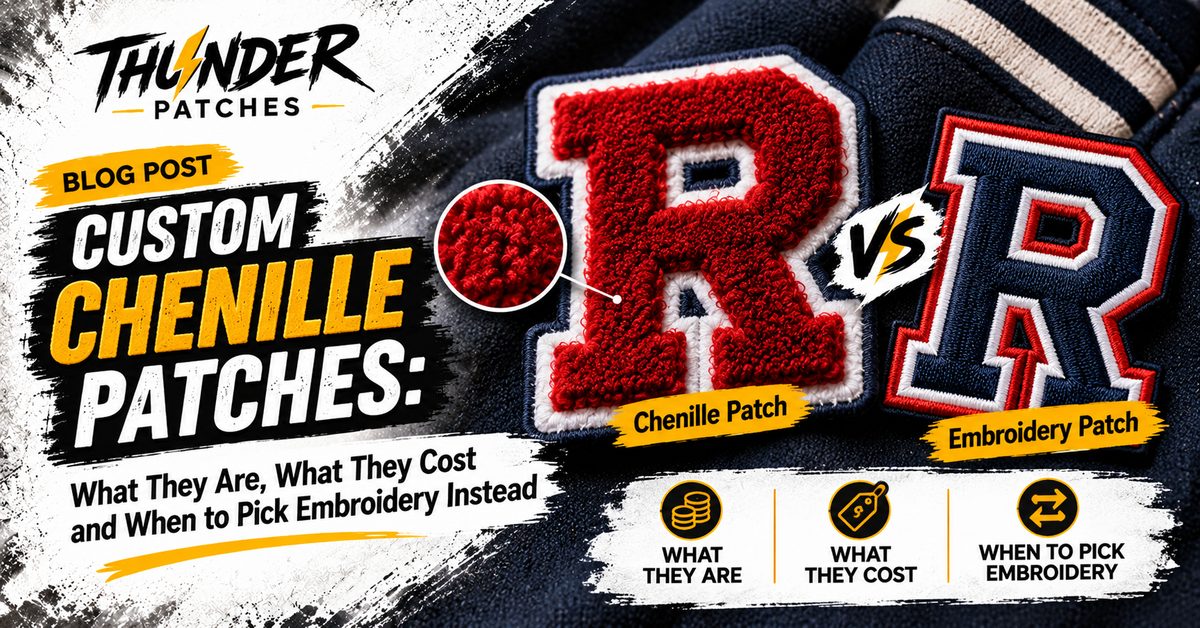
Chenille is the patch you can feel from across the room. It is thick yarn stitched in loops so it stands up off a felt base, like a short, soft carpet. Most people know it from varsity letters. It also works on hoodies, crewnecks, tote bags and retro-style brand merch.
It is not the right patch for every design, though. Here is what chenille does well, where it struggles, and what it costs.
How a chenille patch is built
There are three parts to look at on a chenille patch:
- The felt base. This is the shape of the patch and the color you see around the yarn.
- The chenille yarn. The raised, fuzzy part. It fills the main shapes of the design.
- The border. A clean edge around the patch, often in a second color. On a classic varsity letter this is the band of color that frames the letter.
Because the yarn is thick, chenille fills large areas fast and looks rich. The same thickness is why it can’t do fine detail.
Designs that work in chenille
Chenille wants big, simple shapes. Think block letters, numbers, a bold mascot outline, a star, a lightning bolt, a single word in a heavy font. A good test is to shrink your design to the size of a coin. If you can still tell what it is, it will work in chenille.
Things that don’t work:
- Thin lines and small text. A loop of chenille yarn is far wider than a line of embroidery thread, so anything thin fills in.
- Lots of small color areas. Each area needs room for the yarn to sit.
- Gradients and photos. Those belong on a printed patch.
Size matters more with chenille than with any other type. Most chenille patches are 3 inches or bigger. At 3 inches, keep it to one bold shape or two or three letters. At 5 inches and up, you have room for a short word or a simple mascot.
Chenille or embroidered?
This is the choice most people are really making. Here they are side by side, at the same size, quantity and backing:
| Order | Chenille, each | Embroidered, each |
|---|---|---|
| 3 × 3 in, 25 pieces, sew-on | $8.04 | $5.45 |
| 4 × 4 in, 50 pieces, iron-on | $8.96 | $6.10 |
| 6 × 6 in, 50 pieces, sew-on | $17.05 | $11.57 |
Chenille costs roughly half as much again as embroidery at the same size. What you get for that is texture and presence. An embroidered patch is flatter and sharper. It holds small text, thin outlines and more colors.
Pick chenille when the patch is big, the design is simple and the soft, raised look is the point. Pick embroidered when the design has detail, the patch is small, or the budget is tight. Plenty of orders use both: a chenille centerpiece with small embroidered patches around it.
Where chenille patches go
- Varsity and letterman jackets. The letter, the year and the mascot. Our letterman jacket guide covers letter sizes and where each patch goes, and the letterman jacket patches page has prices for full sets.
- Hoodies and crewnecks. A 4 to 6 inch chenille patch on the chest of a heavyweight hoodie is a popular merch look for brands, bands, schools and clubs.
- Tote bags and backpacks. Canvas takes chenille well, and a single bold letter or icon reads from a distance.
- Back patches. A large chenille patch, 8 to 10 inches, across the back of a jacket or hoodie.
Attaching chenille patches
The backing depends on the garment, not the patch.
- Wool jackets and leather sleeves: sew-on. A hot iron can mark wool and damage leather, and stitching holds a thick patch best.
- Cotton and polyester hoodies, sweatshirts and totes: iron-on works. Press firmly and long enough to melt the glue through the felt. Our guide on ironing on a patch has the heat and timing.
- Anything washed every week: iron it on, then add a few stitches around the felt border. That keeps the edges from lifting.
When you sew, stitch through the felt border, not the chenille yarn. The border is flat and takes stitches cleanly. The sewing guide walks through it.
Wash chenille garments inside out on cold, and skip high heat in the dryer. The pile stays fuller that way.
What chenille patches cost
These come straight from our calculator, in US dollars, with standard delivery and free shipping included:
| Order | Size | Quantity | Backing | Price each | Order total |
|---|---|---|---|---|---|
| Test run for a hoodie | 4 × 4 in | 5 | Iron-on | $19.15 | $95.74 |
| Merch drop | 4 × 4 in | 50 | Iron-on | $8.96 | $448.12 |
| Bigger chest patch | 5 × 5 in | 100 | Iron-on | $9.75 | $975.40 |
| Small icon, large run | 3 × 3 in | 250 | Iron-on | $3.53 | $882.98 |
| Back patch | 8 × 8 in | 25 | Sew-on | $38.60 | $964.91 |
| Large back patch | 10 × 10 in | 10 | Sew-on | $55.16 | $551.57 |
The price per piece drops at 10, 50, 100, 250, 500 and 1,000 pieces, so the jump from 5 to 50 cuts the price of a 4-inch patch by more than half. If you are close to a break, price the next one up in the calculator before you order.
Timing
Your free mockup arrives in 12 to 24 hours. Standard delivery is 11 to 15 business days after you approve it, and rush is 5 to 7 business days for 25% more. For a merch launch or a school event, three weeks from the first message to patches in hand is comfortable.
Picking colors
Chenille is usually two or three colors: the yarn, the felt and the border. That limit is part of the look, so lean into it.
- Contrast first. Cream yarn on navy felt reads from across a room. Gold yarn on orange felt does not.
- Think about the garment. A patch that matches the hoodie color too closely disappears. A border in a darker shade frames the patch and separates it from the fabric.
- Match school or brand colors by name. Send the color names, Pantone codes or a photo, and the mockup shows the yarn and felt colors we would use before anything is made.
Common mistakes
- Ordering too small. A detailed 2-inch chenille patch turns into a fuzzy blob. Go bigger or switch to embroidery.
- Too many words. One word or two or three letters is the sweet spot. A full slogan belongs on an embroidered or printed patch.
- Ironing onto wool. Heat can mark the jacket. Sew it on instead.
- Forgetting the year. If the design includes a date, you will need a new run next year. Put the year on its own small patch and keep the main design timeless.
Before you order
- Check the design at full size. If any line is thinner than a pencil, simplify it or switch that part to embroidery.
- Pick two colors that contrast: one for the yarn, one for the felt or border.
- Decide the backing from the garment: sew-on for wool and leather, iron-on for cotton and polyester.
- Start with 5 if you are testing a look. The minimum is 5 pieces for every design.
The chenille patches page has the calculator for any size and quantity, and you can send your artwork there for a free mockup.
Patches mentioned in this guide
Leather patches · Iron-on patches · Cheap custom patches · Jacket patches · Logo patches for businesses
Ready to order custom patches?
See your price instantly. Get a free mockup in 12 to 24 hours. Nothing is made until you approve it.