 Thunder Patches
Home / Blog / Custom patches for scout troops, packs and youth groups
6 min read
Custom patches for scout troops, packs and youth groups
Troop patches, camporee and event patches, patrol patches and trading patches: what to order, how big to make them, how to budget per scout, and real prices from 5 pieces.
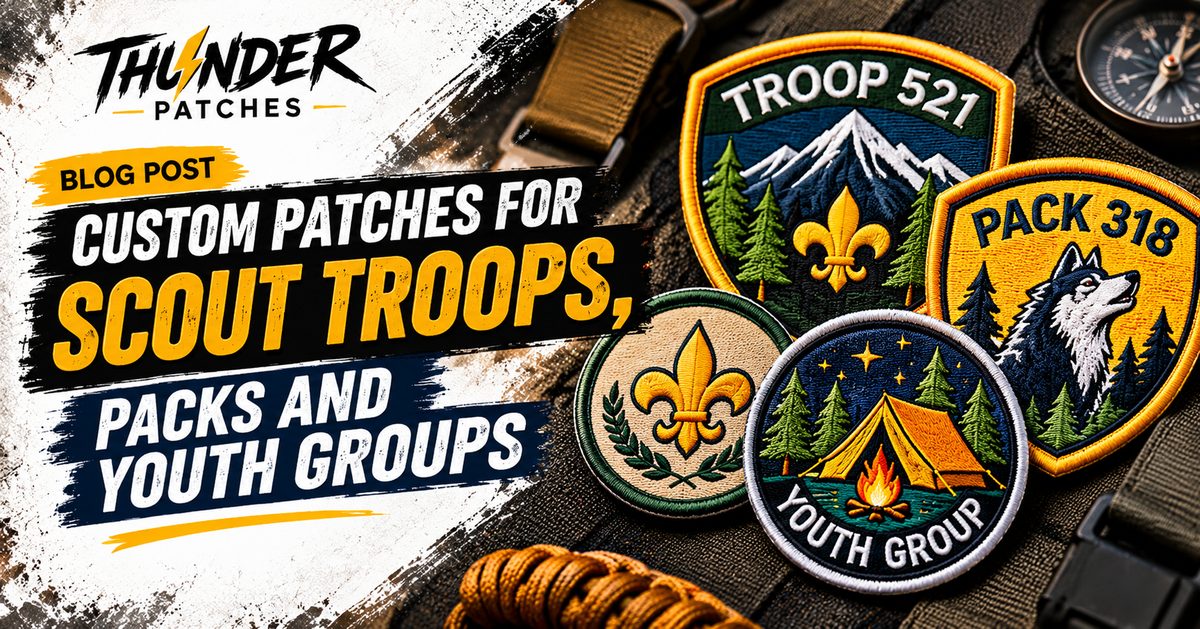
Youth groups go through patches fast. Every campout, every service project and every summer camp is a reason for one. Official rank and merit badges come from your scouting organization. Everything else, the troop patch, the camporee patch, the patrol patch and the patch you trade at a jamboree, you can design and order yourself.
Here is what troops usually order, how to size it, and what it costs per scout.
The patches troops and packs order most
- Troop or pack patch. The group’s name, number and town, sometimes with a simple emblem. Ordered once and reordered as new members join.
- Event patches. Camporees, campouts, hikes, canoe trips, food drives. One design per event, given to everyone who took part.
- Summer camp patches. Camps and councils order these for every camper, often with the year on them.
- Patrol and den patches. A small patch per patrol or den, usually an animal or a symbol the kids picked.
- Trading patches. Made to swap at jamborees and big gatherings. These are often the most fun to design.
- Leader and volunteer patches. A thank-you patch for parents and leaders who drove, cooked or ran an event.
Where the patches go
Uniform rules vary between organizations, so check your own insignia guide before you sew anything onto a uniform shirt. Most groups give event patches a home that is not the uniform itself:
- A patch vest or a camp blanket, where scouts collect event patches over the years.
- A backpack, duffel or day pack.
- A troop hoodie or jacket.
- One temporary spot on the uniform, if your organization’s guide allows it, for the current event or camp patch.
Knowing where it goes tells you the backing. Patches for blankets and vests are usually sewn on. Patches for backpacks and hoodies can be iron-on, which is quicker for parents. The guides on sewing on a patch and ironing on a patch cover both.
What size to make them
| Patch | Usual size | Why |
|---|---|---|
| Event or camp patch | 3 to 3.5 in | Big enough for a name and a date, fits a blanket grid |
| Troop or pack patch | 3 to 4 in | Room for the number and the town |
| Patrol or den patch | 2.5 to 3 in | One symbol and a short name |
| Trading patch | 3 in | Easy to carry a stack, cheaper per piece |
| Back patch for a jacket | 8 to 10 in | Reads from across a field |
Our patches start at 2 inches on each side. Most troops land on 3 inches for event patches because it fits a lot of text and keeps the cost down. For more on sizing, see the patch size guide.
Designing a patch kids will want to keep
The best youth patches are simple and specific. A canoe, a mountain, a campfire, the date and the name of the event. That is usually enough.
- Let the scouts draw it. A drawing on paper, photographed in good light, is a fine starting point. We redraw it for the mockup.
- Keep text short. The event name and the year. Skip long mottos at 3 inches.
- Use bold shapes. Thin lines and tiny lettering don’t stitch well at small sizes.
- Pick a shape. Round and shield shapes are classic, but a custom outline, like a canoe or a tent, makes trading patches stand out.
- Add the year to event patches, not the troop patch. The troop patch should last for years of reorders.
More tips on files and sketches are in how to prepare artwork for custom patches.
Trading patches
At big gatherings, scouts swap patches with troops from other towns and states. A good trading patch says where you are from at a glance.
- Put your place on it. The town, the state shape or a local landmark. Kids want patches that tell a story about where they came from.
- Make plenty. Each scout usually needs a handful to trade, plus a few to keep. Multiply the number of scouts going by five or ten.
- Try an unusual shape or detail. A custom outline or a glow-in-the-dark thread accent makes a patch easy to trade. Glow thread adds $0.25 a piece on embroidered patches.
- Keep them the same size. 3 inches is easy to carry in a stack and keeps the cost per piece low.
Which patch type to choose
Embroidered is the default for youth groups. It is durable, it handles bold designs and bright colors, and it is the best value at most sizes. Woven is worth it when the design has small text, like a council name around a border. Printed works for designs drawn in full color, like a kid’s artwork with shading. PVC suits gear that gets wet, though it costs more.
What it costs per scout
Real prices from our calculator, in US dollars, with standard delivery and free shipping included:
| Order | Size and type | Quantity | Price each | Order total |
|---|---|---|---|---|
| Small patrol | 3 × 3 in, embroidered, sew-on | 10 | $5.45 | $54.52 |
| Troop event | 3 × 3 in, embroidered, iron-on | 25 | $5.50 | $137.56 |
| Pack or troop with families | 3 × 3 in, embroidered, iron-on | 50 | $3.87 | $193.34 |
| District camporee | 3 × 3 in, embroidered, iron-on | 250 | $2.41 | $603.18 |
| Full-color camp patch | 3 × 3 in, printed, iron-on | 100 | $2.50 | $249.88 |
| Patrol patch | 2.5 × 2.5 in, embroidered, sew-on | 50 | $2.85 | $142.55 |
The price per piece drops at 10, 50, 100, 250, 500 and 1,000 pieces. Two things help a youth group budget:
- Order for the whole season at once. If you know you will run three campouts, ordering the troop patch plus spares in one bigger run costs less per patch than three small ones. Each design is still its own order with a 5-piece minimum.
- Round up to the next break. If you have 45 scouts, check the price at 50. You often pay little more in total and have spares for new members.
Sew-on backing adds nothing to the price, iron-on adds $0.05 a piece and velcro adds $0.25. Economy delivery saves 5% if you have the time. For a group that orders patches often, the cheap custom patches page lists every way to bring the price down.
Plan around the event date
Patches are best handed out at the event or at the next meeting, not two weeks later. Work back from the date:
- Send the design. Your free mockup arrives in 12 to 24 hours.
- Get sign-off from whoever needs to approve it, and ask for changes if needed. Changes to the mockup are free.
- Standard delivery is 11 to 15 business days after you approve the mockup. Rush is 5 to 7 business days for 25% more.
Three to four weeks before the event is comfortable. The timeline guide has more detail.
Before you order
- Count scouts, leaders and a few spares. Late joiners always turn up, and a reorder of five costs more per patch than adding five to the first run.
- Check your organization’s uniform rules if the patch goes on a uniform.
- Decide the backing by where it goes: sew-on for blankets and vests, iron-on for packs and hoodies.
- Keep the troop patch timeless and put dates on event patches.
Send a sketch or a logo for a free mockup on the embroidered patches page, or use the calculator there to price your own size and quantity.
Patches mentioned in this guide
Iron-on patches · Velcro patches · Jacket patches · Logo patches for businesses
Ready to order custom patches?
See your price instantly. Get a free mockup in 12 to 24 hours. Nothing is made until you approve it.