 Thunder Patches
Home / Blog / How to remove a patch without damaging your clothes
4 min read
How to remove a patch without damaging your clothes
Whether it is sewn, ironed or glued, you can take a patch off cleanly. Here is the safe method for each type.
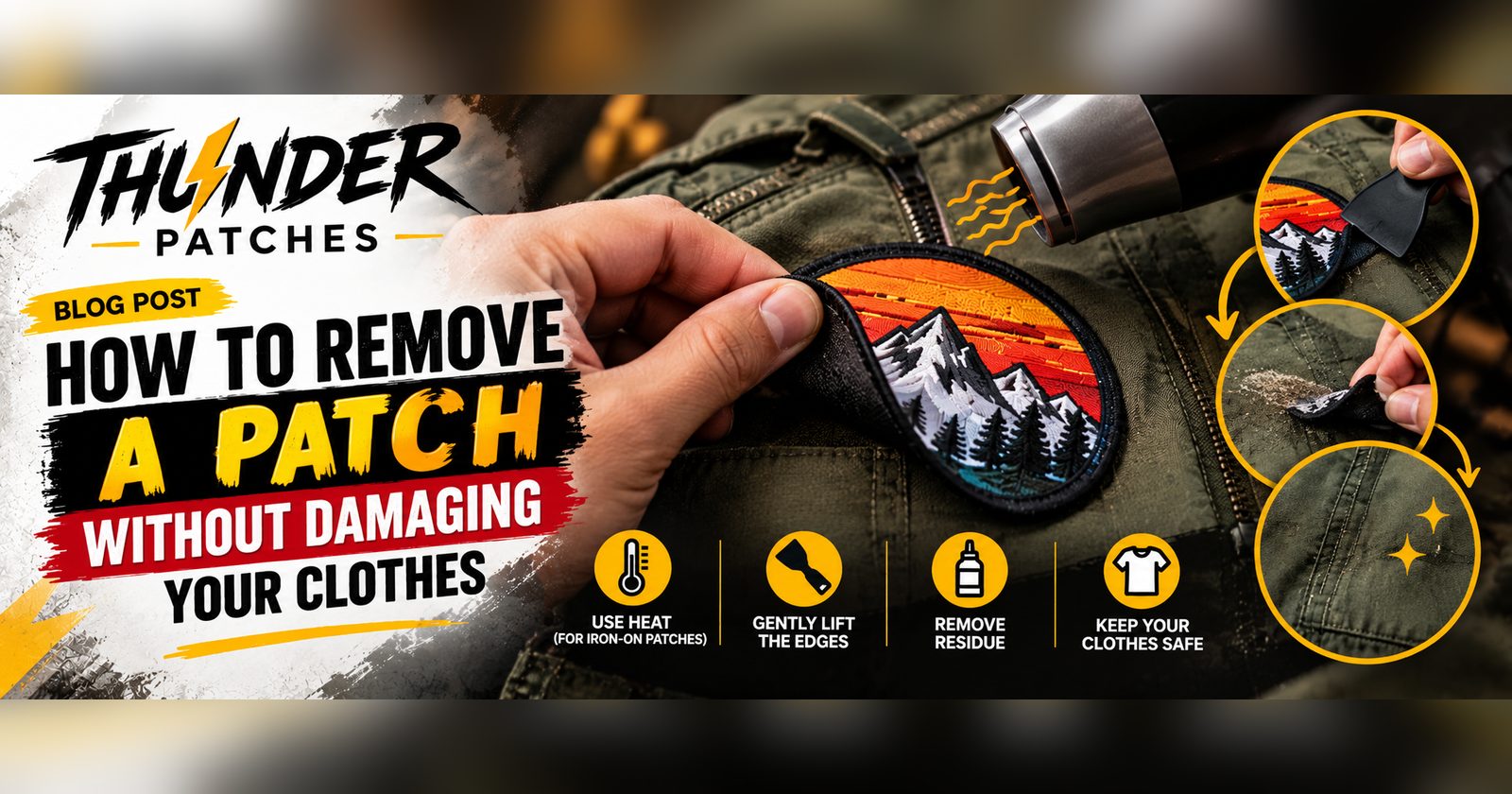
Patches are meant to be permanent, but things change: a team changes its colors, a design goes out of date, or a patch ends up crooked. The good news is that most patches come off cleanly if you are patient.
Removing a sewn-on patch
- Turn the garment inside out if you can see the stitches from behind. Otherwise work from the front.
- Use a seam ripper or small, sharp scissors to cut the stitches along the patch edge. Cut every few stitches, not the fabric.
- Pull the loose thread out gently with tweezers.
- Lift the patch away. If the fabric is marked with tiny holes, a gentle steam or wash usually relaxes them.
Removing an iron-on patch
- Place a thin cloth over the patch.
- Press with a warm iron for 15 to 20 seconds to soften the glue.
- Lift a corner with a butter knife or tweezers and peel slowly. Reheat if it resists.
- Remove leftover glue by dabbing it with rubbing alcohol on a cloth, then wash the garment.
Removing a velcro patch
Pull the patch off. If you want the loop panel off too, cut the stitches around it. Learn more about velcro patches.
Tips to avoid damage
- Test any solvent on a hidden spot first.
- Do not rip. Slow and steady wins.
- Keep heat low on delicate fabrics, and avoid it on nylon and synthetics.
Want a patch you can swap?
If you often change patches, choose velcro backing from the start. Or, for a quick and removable bond, see our guide to choosing a backing.
Before you start
- Identify the backing. Look for stitches (sew-on), a stiff glue layer (iron-on) or a soft hook-and-loop panel (velcro).
- Check the fabric. Delicate fabrics need low heat and extra patience.
- Gather tools. A seam ripper, small scissors, tweezers, a thin cloth, an iron, and rubbing alcohol.
- Work in good light. You are cutting thread close to the fabric, so you need to see it.
Which method for which garment?
| Garment | Best approach |
|---|---|
| Cotton jacket or jeans | Cut stitches, or heat and peel for iron-on |
| Nylon or synthetic jacket | Avoid heat. Cut the stitches |
| Cap or hat | Cut stitches slowly, supporting the crown |
| Bag or backpack | Cut stitches, or pull off the velcro patch |
Fixing marks after removal
- Needle holes: a gentle wash or light steam usually relaxes them.
- Faded outline: a patch can protect the fabric from sun and wear, so the covered area may look darker. A new patch of the same size, or a slightly larger one, can cover it.
- Glue residue: dab with rubbing alcohol, test it first on a hidden spot, then wash the garment.
When not to remove a patch
If the fabric is thin or old, removing a patch can tear it. Consider covering the old patch with a larger one, or moving the garment into backup use. For a patch you often change, plan ahead and choose velcro from the start.
Frequently asked questions
Can I reuse a patch after removing it?
Often yes. A sew-on patch can be sewn on again. An iron-on patch may lose some of its glue, so add a few stitches around the edge. See how to iron on a patch and how to sew on a patch.
Will removing a patch leave a hole?
Stitch marks are tiny and usually relax. A thick or tight stitch pattern can leave more visible marks.
Is it safe to use heat on every fabric?
No. Avoid heat on nylon and other synthetics, and keep it low on delicate fabrics.
A calm, step-by-step approach
Removing a patch is mostly about patience. Work in good light, with the garment flat on a table. Take a few minutes to look at how the patch was attached before you cut or heat anything, because the wrong method can mark the fabric. Work in small sections, and stop if the fabric starts to pull. If a patch fights back, rest it, re-warm it or cut a few more stitches, instead of pulling harder. Once it is off, clean the area gently, and check the fabric before you decide whether to attach a new patch in the same place or a slightly different one.
Keep reading
Choosing the right backing avoids this problem. Read iron-on, sew-on or velcro, or browse iron-on patches, velcro patches and morale patches. To replace an old patch with a new one, use the instant price calculator.
Patches mentioned in this guide
Hat patches · Jacket patches · Sports team patches
Ready to order custom patches?
See your price instantly. Get a free mockup in 12 to 24 hours. Nothing is made until you approve it.